If you’re a woman and a regular drinker, you might very easily fall into the heavy-alcohol-user category. That’s because, when you look at the signs of binge-drinking, it’s scarily easier to achieve than you’d think. And from the number of dwindling nightclubs and bars globally, it seems many other people are uncoupling from booze. But not South Africa, where binge-drinking and heavy alcohol use remain higher than Seth Rogan on any given Sunday. Post-Dry January or OcSober, the harsh reality is that binge-drinking is everywhere.
How Bad Is Alcoholism In South Africa?
The alcohol statistics in South Africa are grim – very grim. In 2019, the Indigo Wellness Index, an indicator that ranks just under 200 countries by various health metrics, dubbed South Africa the unhealthiest nation. In other indexes, we’re nowhere near the top. Where do we score so poorly? Obesity, low life expectancy and alcohol consumption. Yep, we’re a country of boozers.
We also have the highest occurrence of foetal alcohol syndrome in the world, according to multiple estimates. The global average for FAS is around 7.7 per 1 000 people. In South Africa, that number sits between 57 and 199 – over seven times higher than the global average, on the lowest end of the scale. According to a joint UCT and South African Medical Research Council (SAMRC) research project, South Africa also wears the crown for being one of the drunkest, with some of the highest rates of binge-drinking in the world. Per estimates, alcohol contributes to around seven percent of all diseases in the nation.
Key Alcohol Definitions
Before we stare into the grim, self-inflicted reality of things, a few necessary numbers.
What is one unit of alcohol?
One unit of alcohol is so defined because it’s the typical amount of alcohol an adult liver can metabolise in one hour. What that means? When a drink label has the percentage of alcohol as 12%, it means that 12% of that drink is pure alcohol.
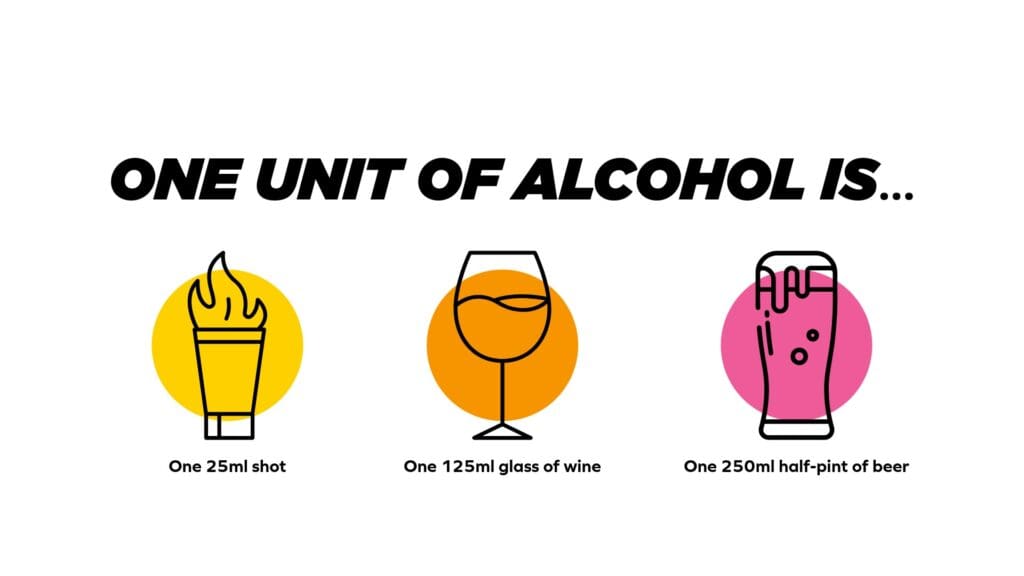
What one drink looks like…
- Spirits: 1 shot (25ml)
- Wine: 1 glass (125ml)
- Beer or cider: half a pint (around 250ml; 3.5-4% alcohol)
To do the math, you can calculate your units by multiplying the units of alcohol (in %) by the volume of liquid (in ml) and dividing that by 1 000. For example, if you were to split a full 750ml of 13% rosé with your BFF, you’d end up taking in five units.
READ MORE: These 13 Simple Mocktails Are So Good, You’ll Make Them Long After Dry January
How do you know if you’re safe to drive?
In South Africa, the legal driving limit is a breath alcohol content of 0.24mg per 1000ml or a blood alcohol limit of 0.05g per 100ml. Too lazy? Use this blood alcohol content calculator to see if you’re fine to drive.
What Is Binge Drinking?
Now, it’s clearer how to tell if you’re a binge drinker. If you drink more than four drinks over a period of two hours more than five times a month, you are considered a heavy alcohol user and are binge-drinking. So, three 175ml glasses of wine (based on 13 percent ABV) and I’m binge drinking? Yep!
According to the 2015 – 2020 Dietary Guidelines for Americans, “moderate” drinking means drinking one unit of alcohol a day. For women, low-risk drinking is defined as no more than three units of alcohol on any single day. And less than seven units of alcohol per week.
READ MORE: Mindful Drinking: How More And More People Are Becoming ‘Sober Curious’
What Is Heavy Drinking?
The Substance Abuse and Mental Health Services Administration have defined “heavy alcohol use” as “binge drinking” five days within one month. The Centers for Disease Control and Prevention (CDC) has capped the number at eight drinks total per week for women (and 15 for men).
How much do other South African women drink?
“But wine is a food group,” we often exclaim, while cooking and sipping and prancing around the kitchen. It seems that for the typical woman in her thirties, we’re living a busy, active, sporty life – and consuming a whole lot of alcohol in between. To check, WH ran polls on our social media accounts to gather data from other fit, health-conscious Women’s Health readers.
Twenty-three percent of Women’s Health readers said they consume alcohol a few times a week or more. The rest consume once a week or less. Fifteen percent of you admitted that you, too, fell into the “heavy drinking” category.
Nationally, the figures are far worse. The Medical Research Council says that 60% of South African drinkers are bingeing. And, of the 30-43% of Saffas that drink, the average consumption is about five to six units per day – that’s half a bottle. Every day.
Why Is Heavy Alcohol Consumption Unhealthy?
The effects of heavy drinking on women are well documented, but in 2023, the World Health Organisation took things further. They found that no amount of alcohol consumption can be called “safe”. That’s because alcohol is a toxin, capable of causing cancer and organ damage, even at low levels.
For physical health, heavy drinking affects the liver, pancreas and can cause any number of cancers, along with strokes and high blood pressure. According to the Canadian Centre on Substance Use and Addiction, these risks creep up from as little as three drinks per week.
READ MORE: How To Do The Festive Season Sober, Plus The 15 Best Alcohol-Free Drinks
Signs you have a binge-drinking or alcohol problem
According to Mayo Clinic, these symptoms mean you should re-look your relationship to booze:
- Drinking more than you wanted to on several occasions
- Blacking out regularly
- Being defensive about your drinking
- Engaging in risky behaviour (while drinking)
- Wanting to cut down on your drinking – but being unsuccessful
- Spending a significant amount of time drinking, or recovering from drinking
- Craving alcohol
- Missing obligations because of alcohol
- Drinking even when you know it could cause a problem
- Drinking when unsafe
- Experiencing withdrawal from alcohol, such as nausea, shaking, or sweating
Free South African Resources For Women
If your alcohol habits are interfering with your life, reach out to these resources.
- Alcoholics Anonymous South Africa: 0861 435 722
- South African Depression & Anxiety Group: 0800 21 22 23 or 0800 456 789 (24-hour helpline)
- Substance Abuse 24-hour Helpline: 0800 12 13 14
- Lifeline South Africa National Counselling: 0861 322 322 (24-hour crisis helpline)