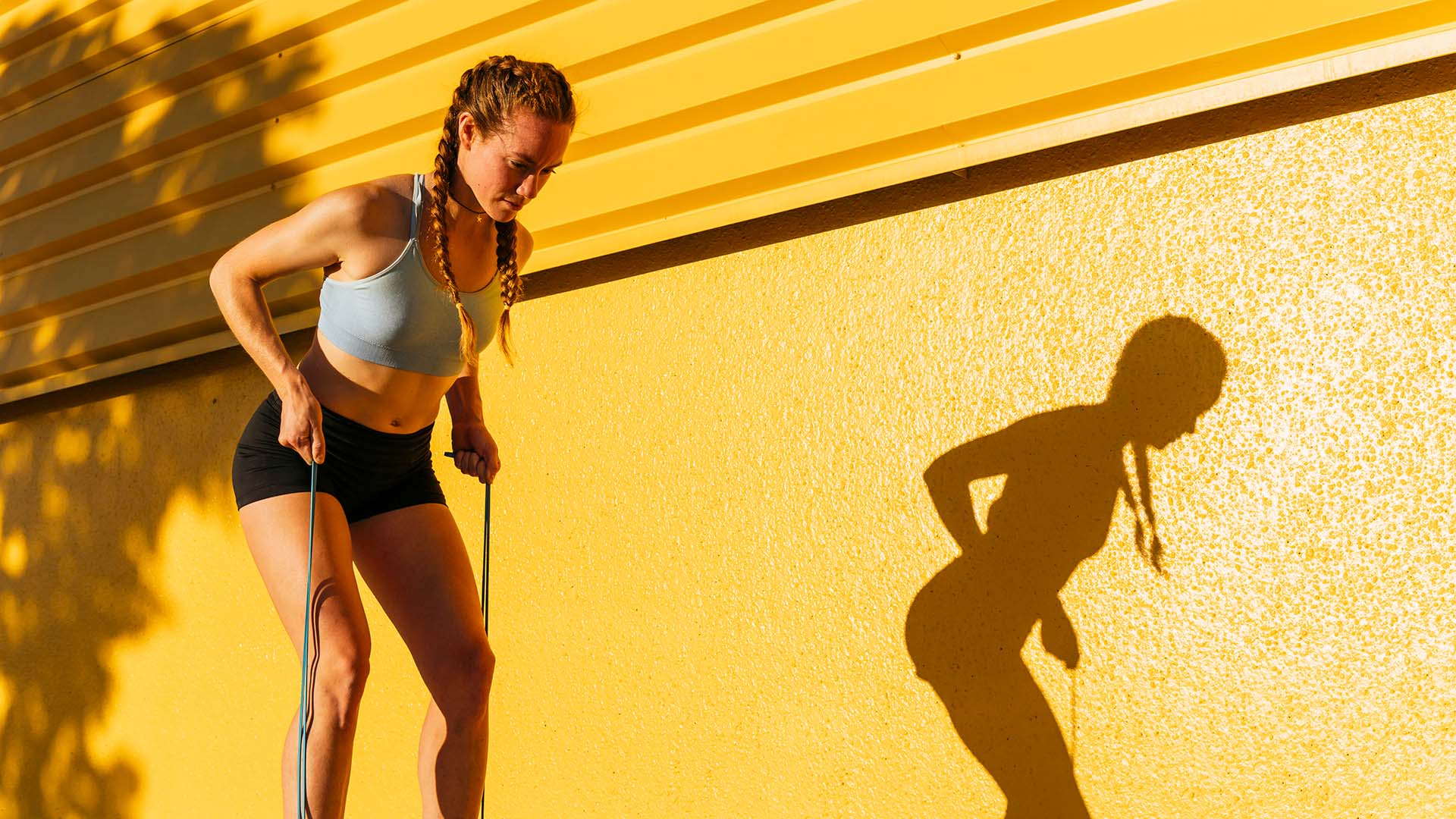
Are your dumbbell exercises getting stale? Good news: you can totally strengthen and sculpt your arms without them. All you really need is a resistance band or two. Oh and the top exercises to create an effective resistance band arm workout, of course!
Gains For Every Level
It’s true. Resistance bands can get your muscles firing just about as well as dumbbells (particularly in upper-body moves), according to a 2018 study published in the Journal of Human Kinetics. They’re pretty much guaranteed to light up every muscle in your arms – biceps, triceps and shoulders, says Rachel Nicks.
There’s a lot to these stretchy strength training tools. “Resistance bands are a great workout for all levels of experience because they create constant tension when contracting your muscles through any range of motion,” adds Rachel Pieroni. “This makes resistance bands incredibly effective because you’re moving equally through the concentric (muscles shortening) and eccentric (muscles lengthening) parts of a muscle contraction.”
And, whether you’re a beginner or advanced athlete, resistance bands should have a place in your routine because they are incredibly versatile and can be used to target *any* area of the body, not just your upper bod. “For beginners, they are convenient and easy to use because they can help achieve major gains while also preventing injury,” says Pieroni. “For advanced athletes, they can be used alone as accessory-style exercises or in combination with more traditional weightlifting exercises, in an effort to overload certain muscles.”
Meet the experts: Rachel Nicks, CPT, is a certified personal trainer certified in Hatha yoga, barre, kettlebell, Pilates and a prenatal and postpartum fitness instructor. Rachel Pieroni, CPT, is a certified personal trainer and Pure Barre training evaluation specialist.
As for how to get started? Read on for a customisable, 25-minute resistance band routine, created by trainers.
Time: 25 minutes
Equipment: resistance band
Good for: arms and upper body
Instructions: Choose 10 exercises from the list below, making sure to pick a mix that work different muscle groups. Complete the indicated reps for each and then continue to the next move. Once you’ve performed all 10, rest for two minutes. Repeat twice more for a total of three rounds.
1. Superman Banded Pull-Down
Arm muscles worked: shoulders
How to:
- Lie on stomach with arms holding a resistance band and legs fully extended while keeping head relaxed and spine neutral by looking at the floor.
- Contract core muscles to stabilise spine, while simultaneously raising both legs and straight arms a few inches off the ground, keeping head and neck neutral.
- Keep arms and legs elevated and bend elbows to pull the resistance band to chest. That’s 1 rep.
2. Overhead Pull-Apart
Arm muscles worked: shoulders
How to:
- Start standing with feet shoulder-width apart, holding a resistance band taut between hands, arms straight at sides, palms facing body.
- Without bending elbows, pull hands apart and raise arms up overhead and back as far as is comfortable. Slowly return to start. That’s 1 rep.
3. Side Plank Triceps Extension
Arm muscles worked: triceps
How to:
- Get into a side plank position, with the left forearm on the floor and feet stacked, right on top of left, so body forms a straight line from head to foot.
- Hold a resistance band in between hands, with elbows wide, arms bent at 90 degrees and right forearm at shoulder height.
- Extend right fist overhead, then reset. That’s 1 rep.
READ MORE: The 6 Best Resistance Bands For Every Type Of Workout, According To Certified Trainers
4. Lateral Raise
Arm muscles worked: shoulders
How to:
- Stand with knees slightly bent, feet staggered, right foot forward and flat on the floor, left back (heel high), with the middle of a resistance band looped underneath the arch of right foot, hands grasping it by the ends and arms at sides.
- Raise arms outward to the sides until parallel to the floor.
- Return slowly to start. That’s 1 rep.
5. Pull-Apart
Arm muscles worked: shoulders
How to:
- Start standing with feet shoulder-width apart.
- Hold a resistance band taut between both hands and extend arms straight in front of the body in line with shoulders and palms facing floor.
- Engage core and pull fists outwards past shoulders. Slowly return to start. That’s 1 rep.
6. Front Raise
Arm muscles worked: shoulders
How to:
- Stand with knees slightly bent, feet staggered, right foot forward and flat on the floor, left back with heel high and with the middle of a resistance band looped underneath the arch of right foot.
- Hold the resistance band by the ends and extend arms down at sides.
- Without bending elbows, raise arms straight up in front of body to shoulder height.
- Slowly lower back down to start. That’s 1 rep.
7. Banded Single Arm Row
Arm muscles worked: biceps
How to:
- Stand with feet staggered so right leg is behind and both knees are bent.
- Wrap a resistance band around left foot and hold ends with right hand, arm extended.
- Keep legs and torso stable and bend right elbow to pull the band backward until hand reaches the right side of ribs.
- Reverse the motion to return to start. That’s 1 rep. Repeat on other side.
8. Single-Leg Row
Arm muscles worked: biceps
How to:
- Stand on right leg with middle of a resistance band looped around arch of left foot, holding on to its ends with hands, keeping arms straight. Hinge at hips so torso and left leg are both parallel to floor.
- Bend at elbows to row hands to sides of rib cage.
- Pause, then slowly lower back to start. That’s 1 rep.
9. Biceps Curl
Arm muscles worked: biceps
How to:
- Start standing on the middle of a resistance band with feet hip-width apart holding its end with hands, arms by sides.
- Bend elbows, bringing hands up in front of shoulders slowly and with control. (Upper arm and wrist should stay still; only the forearm should move.)
- Pause and lower down slowly all the way to the bottom. That’s 1 rep.
READ MORE: The Best Strength Exercises For Female Runners To Prevent Injury, According To Studies
10. Triceps Extension
Arm muscles worked: triceps
How to:
- Stand with knees slightly bent, feet staggered, right foot forward and flat on floor, left back with heel high and with the middle of a resistance band looped underneath the arch of right foot.
- Hold resistance band by ends and extend arms straight up overhead, palms facing each other.
- Keeping upper arms still, bend at the elbows and lower hands to just behind neck.
- Reverse movement to return to start. That’s 1 rep.
11. Shoulder Press
Arm muscles worked: shoulders
How to:
- Stand with knees slightly bent, feet hip-width apart, with resistance band looped underneath the arches of both feet.
- Hold resistance band by ends and raise elbows to shoulder level, bent at 90 degrees, palms facing inward.
- Press hands up overhead until biceps frame face.
- Hold for one second, then take three seconds to lower back to start. That’s 1 rep.
12. Triceps Extension Pulse
Arm muscles worked: triceps
How to:
- From the triceps extension starting position, bend at elbows so forearms are parallel to floor.
- From here, bend elbows more and lower hands slightly by just a few inches.
- Then, return to the starting point. That’s 1 rep.
READ MORE: Here’s How Often You Should Work Out Based On Your Goals, According To Trainers
13. Triceps Kickback
Arm muscles worked: triceps
How to:
- Stand with knees slightly bent, middle of a resistance band beneath feet, hands by rib cage holding ends of band, arms bent at 90 degrees and hips hinged backwards, with torso tilted to 45 degrees.
- Engage core and straighten elbows so hands push back until arms are fully extended behind body. (Only forearms should move.)
- Once arms are straight, pause and then reverse movement to return to start. That’s 1 rep.
Can you get an effective arm workout with resistance bands?
Yes, indeed! Here’s why: “There are many types of resistance bands available, including looped bands, longer looped bands, or bands with hooks and this allows for a ton of variety when programming a workout for the upper body,” says Pieroni. All those options give you room to adjust and progressively overload while keeping constant muscle tension for each exercise you perform, she says. As a result, the moves you do with them are oh so effective. Plus, the more you stretch the band, the more challenging an exercise becomes. That creates increased tension on the active muscles, Pieroni says. Resistance bands offer a killer arm workout thanks to time under tension, which is a smart strategy for maximising strength and building muscle.
Benefits Of Resistance Bands
With resistance bands, you can…
Build muscle
Resistance bands test your muscles throughout the full range of motion of an exercise, so they create a deeper concentration and strengthen your muscles by increasing the time they spend under tension, says Pieroni. “With resistance bands, there is always tension as long as you keep the band lengthened enough for the concentric and eccentric part of the muscle contraction, which has been proven to lead to muscle gains in strength and size,” she says. In other words, your upper body has to put in extra work to maintain the tension throughout the *entire* movement.
Work on functional training
Functional training helps you perform everyday activities more easily, and resistance bands are a gold standard for reaching this goal. “With typical gym equipment you may be limited to only moving in one plane of motion,” says Pieroni. Resistance bands allow for greater range of motion, in addition to allowing work to happen in more than one plane of motion. Plus, “the notable flexibility of any resistance band helps develop a stronger sense of motor control and coordination,” says Pieroni. So, using resistance bands to increase strength in the upper and lower back may make it easier to pick up a child or heavy groceries.
Improve form
“Because resistance bands work in both directions, it’s almost impossible to ‘cheat’ an exercise,” says Pieroni. For example, think about a chest press. With enough force, you might be able to complete a chest press with a heavy set of dumbbells, but you may compromise your form in the process, she says. With resistance bands, though, there is an emphasis on the eccentric part of the contraction (the lowering of the dumbbells in a chest press or lengthening the muscles) and it’s almost impossible to force the resistance bands to full extension (the top of the chest press) if the band is too heavy or you’re reaching a point of fatigue, adds Pieroni. Resistance bands force you to maintain form the *entire* time and use the proper muscles.
Increase overall athletic performance
Whether you’re a fitness newbie or elite athlete, resistance bands can be used to increase athletic performance, says Pieroni. “The beauty about resistance bands is they can be used in stand-alone training or in addition to various training methods,” she says. In addition to upper body muscle gains, which are important for your overall fitness, you can also use a resistant bungee band to work on acceleration and speed training by doing quick sprints. Looking for agility training? Pieroni suggests using a resistance band to perform banded jumps or lateral shuffles.
READ MORE: This Beginner Callisthenics Workout Builds Serious Strength & Mobility
Maintain mobility
Mobility training is non-negotiable and resistance bands are an awesome way to maintain and extend your range of motion. “Resistance bands can aid in mobility and flexibility because they allow for a greater range of motion, which helps lengthen the targeted muscles, thus deepening the stretch,” says Pieroni. And, there are a bunch of benefits to mobility, like preventing injuries, increasing the flexibility of joints and muscles and improved stability and balance.
This article by Andi Breitowich and Olivia Luppinowas was originally published on www.womenshealthmag.com.