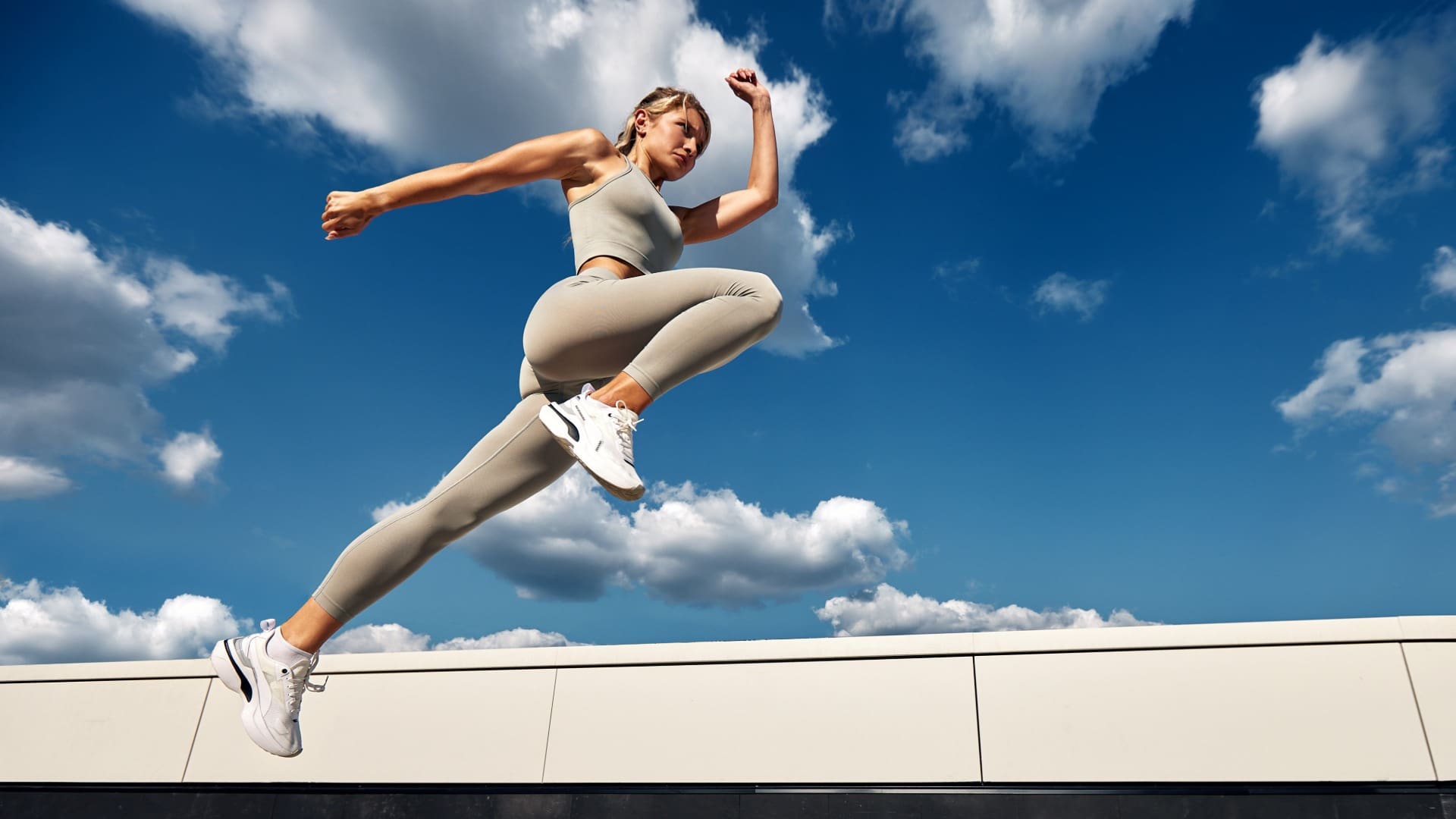
If you want to take your running to the next level, spending time in the gym will do a whole lot of good – maybe even more than increasing road time alone. Lifting weights, power training, and resistance training have plenty of benefits that translate into PBs, fewer injuries and an overall happier time pounding the pavement. These scientifically studied workout types are the best strength exercises for runners to improve mobility and prevent injuries.
Why is running more not the only way to run better?
Getting extended time on the road is an excellent way to improve your running – but it’s not the only way. In fact, experts recommend you embrace cross-training. For one thing, running day after day allows your body to adapt, which can be great for getting used to a new distance – but it can also create a plateau.
Increasing your running distance can up your endurance, but to power that longer mileage, you’ll need muscle strength, improved oxygen uptake and a way to power through fatigue. The good news: plyometrics (explosive strength training) and strength training are the best ways to address those issues. Here, the top methods for building strength for female runners. Best of all, most of these moves require no equipment!
READ MORE: How To Exercise During Perimenopause To Maintain A Healthy Body Composition
1. Balance Training
According to a systematic review of 82 studies from British Journal of Sports Medicine, lower-body balance exercises, agility training and strength training reduced injuries in women’s lower bodies by 19%. The authors also recommend training for balance, change of direction, along with agility, at least twice a week for at least 10 minutes.
Exercises for better balance
Single-leg squat
- Stand tall, feet hip-width apart, and one leg extended forward, core engaged, arms out for balance or holding something sturdy.
- Hinge at your hips and push your glutes back as you squat down as low as you can, chest up and back straight.
- Drive through to return to start, squeezing your glutes. That’s one rep.
Single-leg Romanian deadlift
- Stand with your feet hip-width apart, holding a weight with an overhand grip, shoulder blades tucked, core engaged.
- Keep a small bend in the knees, then hinge down, weight grazing your leg.
- Keep lowering until you feel a deep stretch in the hamstrings, back neutral and not rounded.
- Squeeze your glutes to push hips forward and return to standing.
READ MORE: 4 Moves That’ll Help You Build Seriously Strong Legs
2. Plyometric Training
Both isometric and plyometric training have positive effects on muscle power. This randomised controlled trial compared the effects of isometric strength and plyometric training on endurance running performance. While small, the study found both modalities effective. However, a study in Journal of Strength and Conditioning Research found that plyometric training improved running economy more than isometric training did.
Top plyometric exercises for runners
Skater hops
- Start standing, feet hip-width apart, knees slightly bent. Shift your weight onto your left leg.
- Using your arms for momentum, push off your left leg, moving sideways.
- Land on your right leg, left leg naturally crossed behind the right, right knee bent. Repeat hopping from side to side.
Box jumps
- Stand about 30cm away from the box with your feet hip-width apart. Swing your arms back, hinge at the hips, knees bent.
- Swing arms forward, drive through feet and jump, tucking knees mid-air.
- Land on the box as softly as possible, feet completely on the box, knees over toes.
- Return to stand and step off the box – no jumping down.
Squat jumps
- Stand with feet shoulder-width apart.
- Drop into a regular squat (hips back, chest up) until thighs are parallel to the floor.
- Drive through heels, jumping as high as possible, using arms for momentum.
- Land softly and sink into a squat.
READ MORE: This Explosive Plyometrics Workout Crushes Calories In 15 Minutes
3. Leg Strengtheners
A randomised controlled trial in British Journal of Sports Medicine found that a 24-week, physiotherapist-guided strength training program targeting the hips and core significantly reduces lower-body injuries among recreational runners.
Best leg strengthening moves for running performance
Lunge
- Stand with feet shoulder-width apart. Step right foot back, landing heel up.
- Lower the back leg down, creating a 90-degree angle in the front leg.
- Push through the heel of the front leg to return to standing. Repeat on the left side. That’s one rep.
Calf raises
- Stand on a flat floor (for beginners) or the edge of a step (for advanced) with your heels hanging off.
- Push through the big toe to lift your heels as high as possible. Hold for 1 second at the top.
- Slowly lower your heels back down. If on a step, let them drop slightly below the level of the step to get a stretch. That’s one rep.
Wall sits
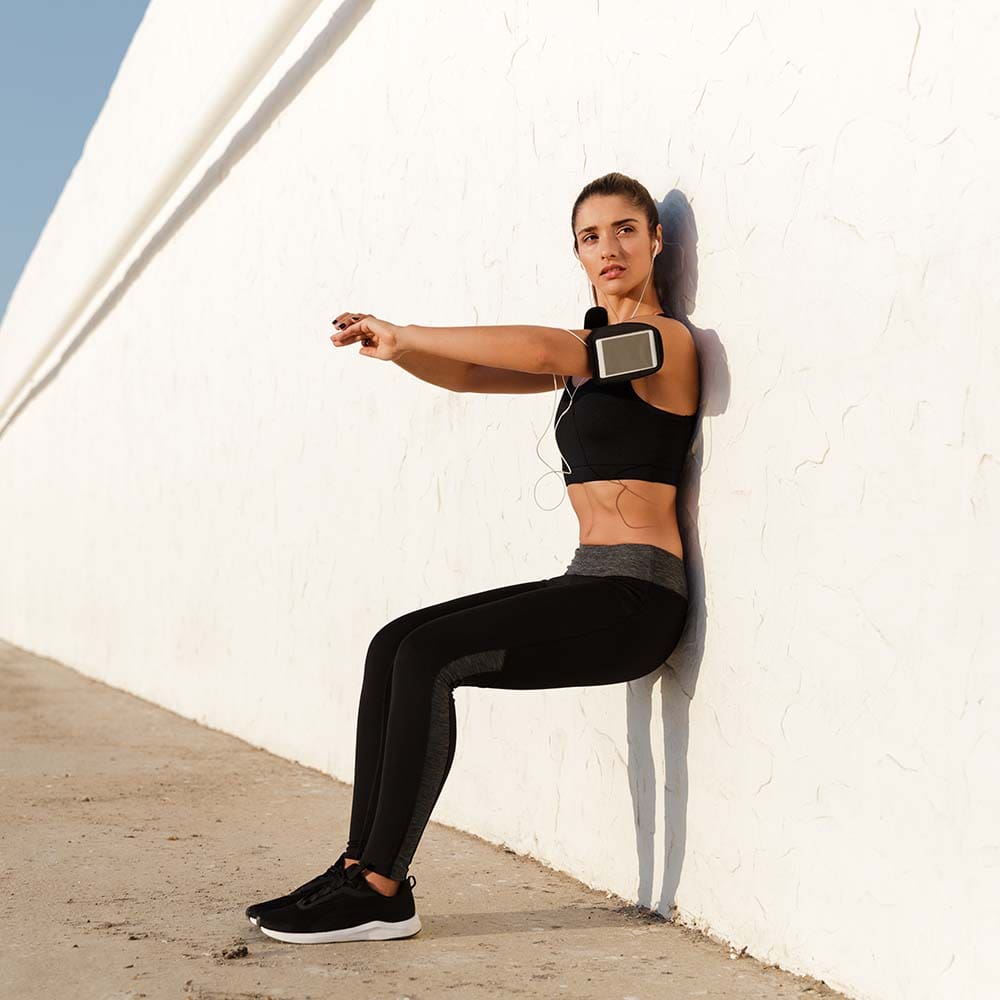
- Lean your back against a flat wall and slide down until your knees are at a 90-degree angle.
- With ankles directly under knees, press entire back into the wall. Keep hands away from your knees.
- Hold for 30 to 60 seconds.
READ MORE: Basic Core Exercises Aren’t Enough – Add These Rotational Moves To Your Workout Now
4. Core Conditioning
A Medicine and Science in Sports and Exercise study noted that weaker core stability may be a risk factor for knee pain from running. And, the same British Journal of Sports Medicine study also found that hip and core exercises were best at lowering injury prevalence.
Workout moves for a stronger core and less knee pain
Plank hold
- Start lying on your stomach and prop yourself up on your forearms, elbows directly under shoulders.
- Engage your core and lift hips off the floor, squeezing glutes to create a straight line from head to heels.
- Lower slowly to start. That’s one rep.
Glute bridge
- Lie on your back, knees bent, feet hip-width apart.
- Squeeze your glutes and lift your hips toward the ceiling until your body forms a straight line. Squeeze for two seconds.
- Return to start.
Dead bug
- Lie on your back. Lift your legs so knees are bent at 90° (tabletop) and reach your arms straight up toward the ceiling.
- Press your lower back into the floor. There should be no gap between your back and the mat.
- Slowly lower your right arm behind your head while simultaneously straightening and lowering your left leg toward the floor. Only go as low as possible, without the lower back lifting off the floor.
- Return to centre and switch sides.
READ MORE: This Free Beginner 10K Running Plan Works In Just 10 Weeks