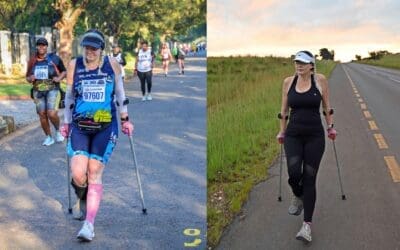
Five years ago, we shared Amber Wright’s story about being diagnosed with breast cancer at just 27. Her life was turned upside down in the blink of an eye, replaced by a whirlwind of clinical rooms and a fight for her future. Today, we’re catching up with a woman who has done far more than just survive. She has spent the last half-decade reclaiming her narrative, navigating the complex reality of medically induced menopause and building a body that is as resilient as her spirit.
As she approaches the end of her hormone treatment this April, Amber opens up about the grit required to train through fatigue, the nutritional pivots that finally shifted the scale and why she is ready to step into a hopeful new season of life.
Rebuilding Strength After Cancer
Movement has been central to Amber’s recovery, but it hasn’t always been easy. Barre has remained the anchor of her fitness routine, even as her training has gradually evolved. “Barre is still my fitness class of choice and has been the foundation of how I move for the past five years,” says Amber. “But over the last three years, my training has really evolved alongside my recovery. As my body has healed and my strength has improved, I’ve found myself pushing harder during classes.”
In the early stages after surgery, rebuilding upper-body strength was particularly difficult. Lymph node removal and the physical impact of treatment meant starting from a much lower baseline than before. “Three years ago, I struggled to use a 1kg dumbbell and focused mainly on bodyweight exercises, especially when it came to arms,” she explains. “My upper-body strength was heavily impacted by my surgeries and lymph node removals.”
Progress came through small milestones that slowly added up. Towards the end of last year, Amber bought her first set of 2kg dumbbells – something that might seem minor to some, but for her it represented a major step forward in her recovery. “That felt like a really big milestone in how far I’ve come in regaining my strength,” she says.
Her weekly routine now includes a mix of Raise The Barre classes, including HIIT and Barre Strength sessions that challenge her without leaving her feeling depleted. Outside the studio, she also plays padel once a week and walks her dog, Phoenix, through the forest several times a week, which she describes as one of her favourite ways to reset mentally.
Looking back, the past year has been particularly significant. “The last 12 months have been huge in my personal fitness journey,” Amber says. “I’ve worked really hard in the gym and in the kitchen, and I’m now stronger, fitter and in better shape than I was even before my cancer diagnosis, which is something I never thought I’d say while still on hormone treatment.”
Navigating Post-Treatment Weight Gain
Weight gain after treatment is something many cancer survivors struggle with, and Amber says it was one of the most frustrating parts of her recovery. For a long time, it felt like her body was no longer responding to the things that had previously worked for her. “Post-treatment weight gain was one of the most frustrating parts of recovery because my body simply didn’t respond to diet and exercise the way it used to,” she says.
“For a long time, it felt like I was doing everything ‘right’ but seeing no changes.”
The turning point came when she approached her nutrition with more structure and consistency. In March last year, she started tracking her calorie intake – something she had previously avoided because she assumed it would feel restrictive. “The biggest turning point for me was getting really honest about consistency,” Amber explains. “I had always thought calorie tracking would feel restrictive, but instead it gave me clarity and control.”
At the same time, she began using recipes from The Lean Girl for most of her meals. The approach helped simplify her nutrition while still allowing her to enjoy food and maintain a balanced diet. “They took the guesswork out of eating delicious food while still keeping things balanced, sustainable and realistic,” she says. “Every meal is packed with protein and I never feel like I’m dieting. As someone who loves food, that was crucial for me.”
Over eight months, those changes helped her lose six kilograms. Once she reached a weight she felt comfortable with, she increased her calorie intake to maintain it. Tracking her food intake also revealed insights she hadn’t expected. “I always believed I ate quite healthily and understood what ‘good’ and ‘bad’ foods were,” she says. “But when you actually see the calorie content of the food you eat, it can be surprisingly enlightening.”
Her training also played a role in maintaining motivation. “I’ve also remained consistent with my training and I’ve been even more motivated to exercise because more calories burnt means more calories to consume,” she says with a laugh. “A win-win.”
The Daily Habits That Support Her Health
For Amber, wellness today is built on simple habits rather than complicated routines. Movement remains non-negotiable, whether that’s a barre class, a walk with Phoenix or a game of padel. But she’s also learnt that the basics – nutrition, sleep and recovery – have the biggest impact on how she feels day to day. “A wellness day for me in 2026 is really about simple, non-negotiable basics done consistently,” she says. “I prioritise balanced meals, hydration and sleep because those are the things that have the biggest impact on my hormones, mood and energy.”
Sleep remains one of the more challenging aspects of her routine. Hormone treatment has significantly affected her rest and fatigue is something she still navigates daily. Being a content creator also means late nights on her phone sometimes creep into her schedule – something she’s actively trying to improve this year.
One important lesson she has learnt along the way is to listen to her body and prioritise recovery when needed. “Rest and recovery are no longer things I feel guilty about,” Amber says. “They’re part of how I stay well.”
Her supplement routine also supports her body while she continues hormone therapy. She currently takes prescribed supplements, including calcium, vitamin D3, magnesium glycinate and vitamin C to help counteract some of the side effects of Tamoxifen and Zoladex. Hair loss – another side effect of being in a menopausal state – has also led her to take a targeted supplement.
One addition recommended by her oncologist has been particularly helpful. “My oncologist suggested I try ashwagandha to help with the dips in mood caused by the treatment,” she says. “That has probably been the most impactful supplement for me. It’s helped me feel less anxious and more emotionally balanced, especially during stressful or busy periods.”
READ MORE: A Lot Of People Get Self-Care Wrong – Here’s How To Build A Routine That Actually Works

How Cancer Changed Her Perspective On Health
Perhaps the biggest transformation over the past five years has been Amber’s mindset. In the beginning, she says she was focused on trying to get back to the person she was before cancer. “My perspective on health has changed completely,” she says. “In the beginning, I was focused on getting back to who I was before cancer, both physically and emotionally.”
But with time came a realisation that recovery wasn’t about returning to the past. “I realised I wasn’t going back, I was moving forward. And honestly, I like this version of myself more. She’s calmer, more grounded and much clearer on what truly matters.”
This year marks another significant milestone. In April, Amber will finish her hormone treatment, bringing an end to more than five years of medically induced menopause. For her and her husband, Nick, that milestone also opens the door to something they have been hoping for. “It means finally being able to try for a baby this year,” she says. “It feels like I’m stepping into a very hopeful new season of life.”
Her journey has also changed the way she views exercise. What once might have felt like routine or obligation now carries deeper meaning. “My journey has taught me to never take my health for granted,” she says. “Training, walking or exercising is not a chore, it’s a gift. There were so many days when I couldn’t get out of bed and couldn’t do half the training I’m doing today.”
The Mental Tools That Still Guide Her
Therapy played a crucial role during Amber’s treatment and many of the lessons she learnt there continue to shape how she approaches life today. One of the most important has been learning to set boundaries and be more intentional about how she spends her time and energy. “When queries, opportunities or demands on my time present themselves, I pause and assess rather than immediately agree and people-please,” she explains.
That shift has helped her avoid overcommitting and made it easier to say no when she isn’t physically or mentally able to take something on. It has also meant learning not to carry emotional burdens that aren’t hers to hold. “I care deeply about people and that will never change,” she says. “But I often found myself carrying emotional stress about things I have no control over.”
Learning to let go of that instinct has been a process and one she hasn’t navigated alone. Her husband Nick often helps her stay aware of when she’s slipping back into those habits. “He’s incredibly good at holding me accountable and gently pointing it out when I start heading down that road again,” she says.
READ MORE: 9 Useful Self-Care Apps For Wellness To Download Now
The Advice She’d Give Her Younger Self
Looking back at the early stages of her recovery, Amber knows how uncertain and overwhelming those years felt. If she could speak to the version of herself who was just starting that journey, her message would be one of patience and reassurance. “You are going to become someone you’re incredibly proud of,” she says. “Not because the journey is easy, but because it will show you just how strong, adaptable and resilient you truly are.”
She would also remind herself not to rush the healing process. “I’d tell her to trust that her body is not failing her, it’s fighting for her and that one day she will feel at home in herself again.”
More than anything, she would remind herself that life after cancer can still hold unexpected opportunities and joy. “This experience will open doors she never imagined,” Amber says, “leading her to a life that feels more aligned, more meaningful and filled with deeper joy than she ever expected.”