
Realising you need to increase your VO2 max, whether from a Vitality cardio fitness assessment or otherwise, is a daunting task. All those numbers. The red on the gradient, and your score – decidedly far from the green end. What’s a busy woman to do? Here, Joanna Keppler, running coach, shares her insights.
Meet the expert: Joanna Keppler is a running coach, runner and real estate specialist who trains women.
What Is VO2 Max And Why Does It Matter?
The dictionary definition outlines VO2 max as how much oxygen your body can use while doing intense exercise – it represents your aerobic capacity. That “V” stands for “volume” – as in, the amount of oxygen, while the O2 means “oxygen”.
The measurement matters because a higher VO2 max is linked to a lower risk of death, lower risk of breast cancer and lower levels of metabolic syndrome. “For women in their 30s, 40s and beyond, maintaining this metric is the ultimate insurance policy for long-term health, energy and race-day performance,” explains Keppler. According to research by Discovery Vitality, these conditions are also linked to low VO2 max scores:
- Cardiovascular disease
- Type 2 diabetes
- Some cancers
What’s A Good VO2 Max For Women?
The average VO2 max for women depends on your age. This chart outlines how scores can be interpreted.
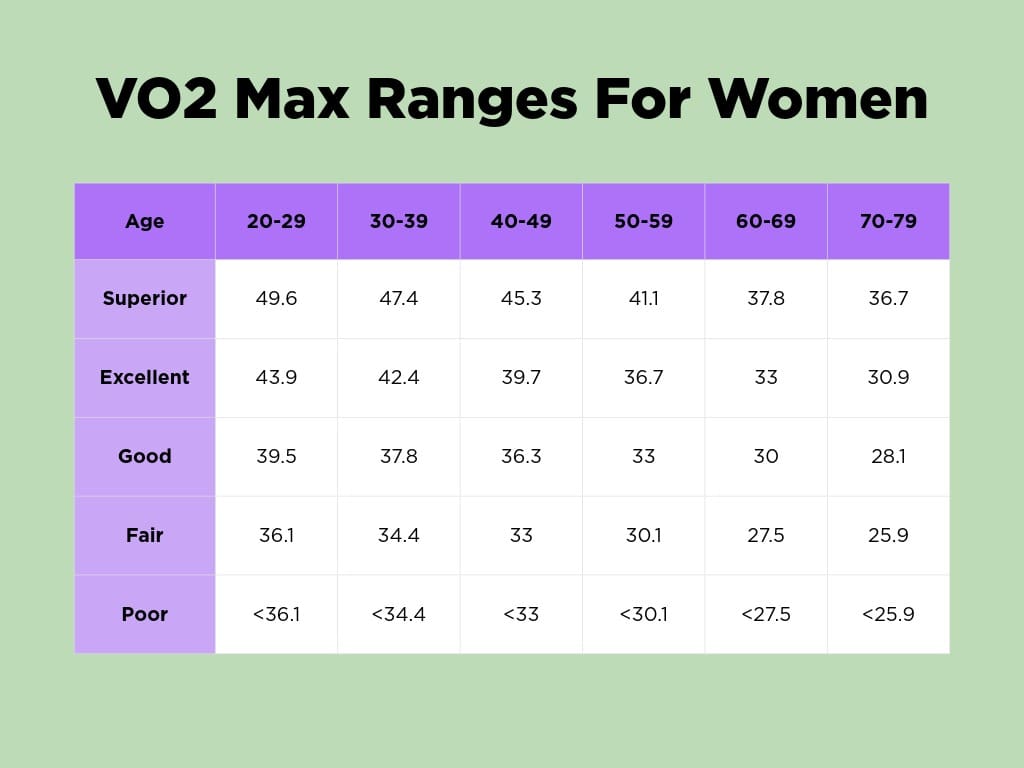
Source: Garmin
READ MORE: The Best Strength Exercises For Female Runners To Prevent Injury, According To Studies
What Influences Your Cardio Fitness Level?
For Keppler, understanding women’s hormonal fluctuations as we age is important. “The traditional ‘gold standard’ [for improving your VO2 max], the 4×4-minute max-effort interval training often fails the woman balancing a career, family, and the first subtle (or not-so-subtle) shifts of perimenopause,” she says. And, for women in perimenopause, which can start as early as your mid-30s, fluctuating hormone levels “can make you feel like your engine has changed overnight,” says Keppler.
How Can You Improve Your VO2 Max As A Woman in Perimenopause?
While you’re trying to increase your Vitality cardio fitness level, your body is negotiating with surges and shrinks of its own, making your energy tank resemble stubborn, unlit kindling with faltering flint. Here’s how it works:
“Oestrogen is a master regulator of energy,” explains Keppler. It supports muscle growth, and lower levels can impact how fast you recover, which impacts your VO2 max. “As oestrogen fluctuates, your power output might drop and your recovery time may increase,” Keppler adds. During this time, maintaining muscle mass becomes more difficult.
The solve? Pick up the HIIT, says Keppler, but keep your intervals shorter. “Shorter, sharper intervals (under 2 minutes) provide the stimulus your heart needs, without the massive cortisol (stress hormone) spike that longer 4-minute intervals can trigger,” she explains. “To increase VO2 max, you need to hit 90-95% of your max effort, but your ability to reach that peak changes with your hormones,” she says. Here’s Keppler’s guide for upping your cardio fitness levels throughout your menstrual cycle.
READ MORE: Cycle Syncing: How (And Why!) To Tweak Your Workouts, Diet And More Around Your Menstrual Cycle
Embrace your power phase
From the day after your period ends up until ovulation, your body is pumped for action. “This is your power phase,” says Keppler. “Oestrogen is rising and your body is primed for high-intensity work. This is the time to go for those 9/10 efforts.”
Your move: heavy lifting, power training, interval sprints
Move in phases
During your luteal phase (the week or so before your period), progesterone rises, which “increases your core body temperature and heart rate. You might feel breathless sooner,” Keppler explains.
Your move: Keep going! But increase the recovery time between intervals to allow your heart rate to recover.
Listen to your body
“On a day where you’ve had 5 hours of sleep, a sick kid, or a stressful work day, your 9/10 effort will be slower than on a rested Sunday morning. Train the effort, not the numbers.”
Prioritise fuel
“Women in our 30s and 40s are often prone to low energy availability. To see VO2 max gains, you must fuel,” says Keppler. “A small amount of carbohydrates before these sessions is non-negotiable to protect your thyroid and hormonal health.”
READ MORE: *Exactly* What To Eat Post-Run To Recover Faster
Recover actively
“Don’t stand still between sets. A very light jog or power walk helps clear lactate and keeps your heart rate in the productive zone for the next peak.”
Focus on starts and finishes
“Don’t forget the non-negotiables. Always frame your high-intensity work with a 10-minute warm-up and cool-down. Dynamic stretching works best pre-run to wake up the muscles and static stretching is your best friend post-run.”
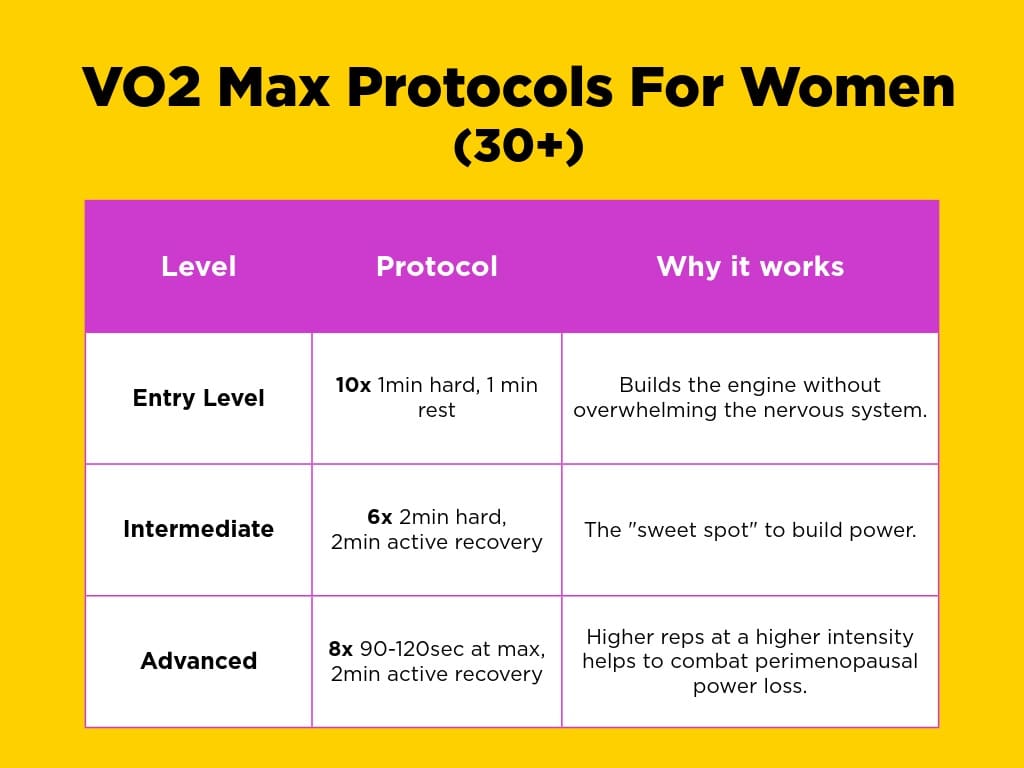
Keppler’s VO2 Max Protocol For Improved Cardio Fitness
This table, made for runners, can easily be adapted to any modality.
READ MORE: Which Is Better: Yoga or Pilates?