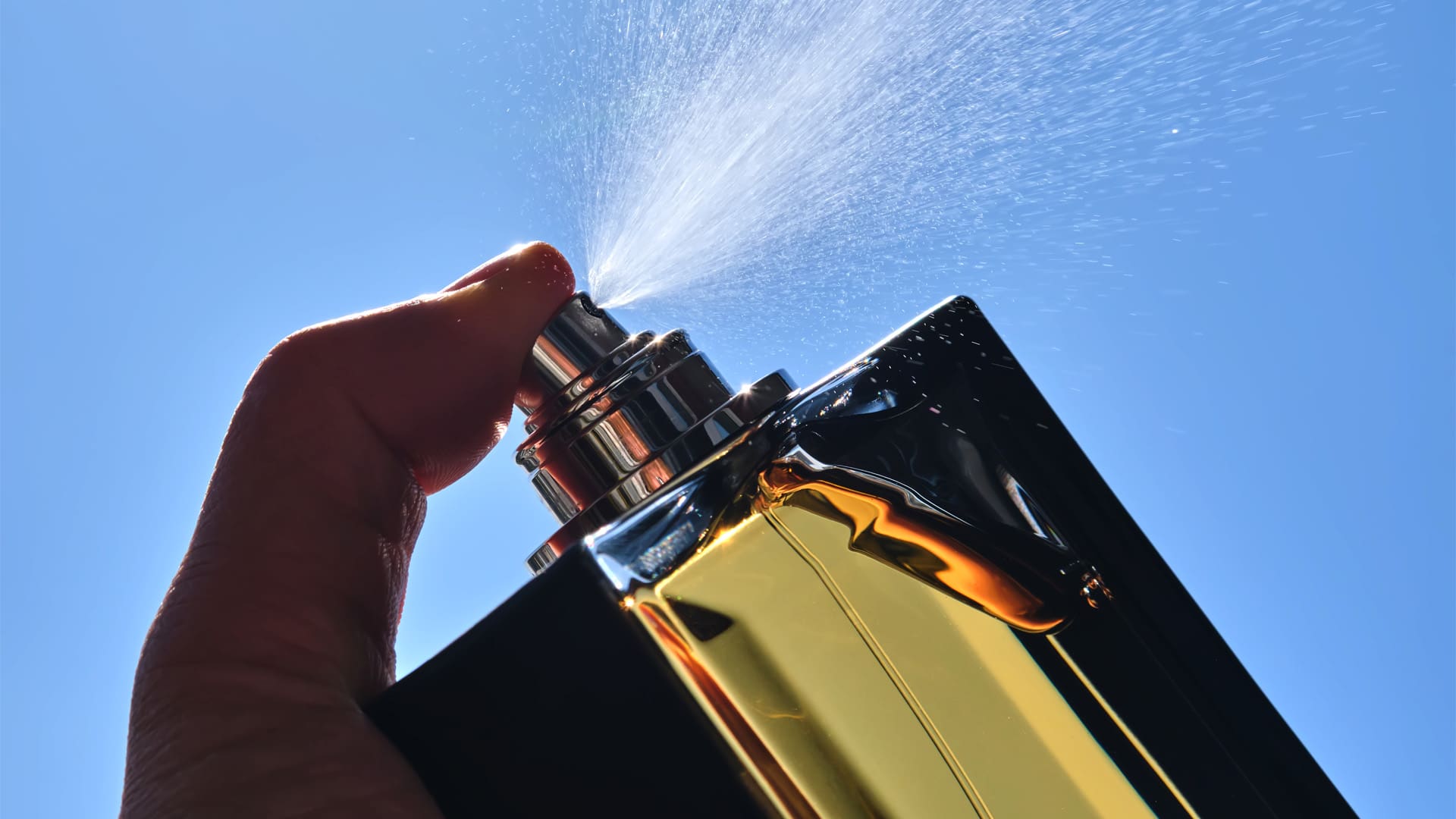
Have you ever walked past someone wearing a strong perfume and instantly got the ick? Or maybe the fragrance your coworker adores gives you a pounding headache? Few things divide people like scent. The same fragrance that evokes warm, comforting memories in one person can trigger a wave of nausea in another.
But why? Is it biology? Your past experience? A personal preference? Or something deeper?
Spoiler alert: It’s all the above. When a particular scent makes you recoil, you’re not being dramatic. You’re just being… you.
READ MORE: The Best Mood-Boosting Scents, According To Science
The Science Behind Scent
The olfactory system, made up of the nose, olfactory bulb and brain regions that process smell, is responsible for detecting odour molecules, and while “humans likely share a core set of common olfactory receptors, there is genetic variation in which of those receptors get expressed,” says Dr Pamela Dalton, a cognitive psychologist and researcher at the Monell Chemical Senses Center. “Some people may simply not be smelling the entire bouquet; their noses could be missing the balancing notes and only picking up the unpleasant ones.”
Meet the experts: Dr Pamela Dalton is a cognitive psychologist and researcher at the Monell Chemical Senses Center. Daryl Do is a senior perfumer at Delbia Do Fragrances. Dr Zara Patel, is a professor of otolaryngology and director of the Stanford Initiative to Cure Smell and Taste Loss at Stanford University. Anna Rosa Parker is the founder of botanical fragrance brand Herb & Root.
In other words, when you and your best friend sniff the same perfume, you may be experiencing two completely different things. “Some people, for example, can’t smell musk at all – they’re anosmic to it,” says Daryl Do, senior perfumer at Delbia Do Fragrances. “Meanwhile, others might find it overwhelming or cloying. It’s so individualised.”
READ MORE: 12 Perfumes That Always Attract Mega Compliments
But aside from biology, experts say our reactions to scent are also shaped by genetics, culture, the nervous system and our emotional memory. So, we asked a cognitive psychologist, a physician and perfumers to help decode why scent is so powerful – and so personal.
When Scent Strikes A Nerve
Sometimes it’s not just about disliking an aroma. In certain cases, a particular waft can make a person physically ill. If that’s you, it’s not your imagination – and your olfactory system may not be to blame. The trigeminal nerve, part of the broader nervous system, detects pressure, temperature and pain in the nasal cavity and face.
When a fragrance contains ingredients that stimulate this nerve (think menthol, bleach or very strong synthetic aromas), it can cause that telltale stinging, tingling, headache-inducing response. “I’m one of those people,” says Dr Zara Patel, a professor of otolaryngology and director of the Stanford Initiative to Cure Smell and Taste Loss at Stanford University. “If I get into an Uber with an air freshener or walk past someone wearing a strong cologne, I’m going to get a migraine.”
READ MORE: Master Trick On How To Pick Your New Summer Signature Fragrance
Did you know? Some fragrance notes are notoriously polarising. According to our experts, the most common are patchouli, musk, oud, vintage florals like rose and jasmine, frankincense and myrrh and linalool, an essential oil.
Why Are Some People More Sensitive?
Allergies, dryness or inflammation in the nasal passages might be to blame. “It’s possible that a person’s particular anatomy allows airflow to hit the nerve in a more direct way than others,” Dr Patel explains.
The amount or concentration of a fragrance matters, too. “Almost every material that is a volatile chemical compound, meaning something that evaporates and is detectable by the human nose, can become a trigeminal stimulant at certain concentrations,” says Dr Dalton.
Your Brain Remembers
While your nose and nerves explain the physical part of scent, your brain helps explain the emotional response – like why you hate musk or can’t smell patchouli without cringing.
Scent is processed in the same part of the brain that governs memory and emotion, which is often why scent is so strongly tied to feelings of nostalgia – a well-studied phenomenon, says Dr Dalton. “We have more evidence for prior memory associations influencing our fragrance likes and dislikes than we do for the biological reasons,” she says.
READ MORE: What Perfumes To Pick Based On Your Holiday Destination
In other words, your brain decides whether a smell is “good” or “bad” based on what it reminds you of, not what it objectively smells like. For instance, Anna Rosa Parker, founder of botanical fragrance brand Herb & Root, says her brand’s Frankincense & Myrrh blend tends to split people into two camps: meditative calm or instant aversion. “I’ve always suspected it ties back to early experiences with religious rituals where frankincense was used,” she says. “For some, that feels comforting. For others, it triggers tension. ”
Patchouli is another loaded note. “It’s among the most complex botanicals we work with,” she says. “People who lived through the 1970s often have an immediate, visceral response – whether that’s nostalgia, disgust or something in between.”
Culture Shapes Scent Preference, Too
Beyond biology and memory, scent preference is also shaped by where – and when – you grew up. “There are definitely patterns in fragrance preferences by demographic,” says Parker. “For example, Baby Boomers and Gen X women often gravitate toward soft floral scents like lily of the valley, which were iconic in the ’50s and ’60s. Millennials tend to favour gourmand notes like vanilla and tonka, which they associate with the body sprays and mists of their teen years.” We see you, Lentheric Kaleidoscope Body Spray.
Geography plays a major role as well. “In the Middle East and South Asia, resinous notes like oud, sandalwood and rose are deeply rooted in cultural tradition,” Parker continues. “In parts of South America, people often prefer fruity, juicy notes; they’re tied to sensory memories of home and family.”
READ MORE: 24 Amazing Spring Fragrances Everyone Will Be Wearing This Season
Still, some scent preferences do transcend cultural lines. A 2022 study published in Current Biology looked at 10 different populations across the globe – including hunter-gatherer groups and urban dwellers – and found that people largely agreed on which scents were pleasant (like vanilla and fruity ethyl butyrate) and which were unpleasant (think sweaty or sulfuric compounds). The takeaway? Biology may create a universal baseline, even if individual preferences are colored by experience.
Make Your Nose Happier
Even if fragrance is challenging for you, you may not turn your nose up at these crowd pleasers. “Certain odours that only activate the olfactory system – and not the trigeminal nerve – are almost universally thought of as winners,” says Dr Patel.
The most beloved? Vanilla. “Across all cultures, vanilla is seen as a safe and comforting scent.”
Other generally safe bets include light florals like lily of the valley, citrus fruits, amber and clean, soapy notes. “These all feel light, familiar and safe,” adds Parker.
And if you’d classify yourself as a scent-sensitive individual, there are ways to navigate the world without constant sensory assault (aside from avoiding elevators and beauty stores)? Talk to your doctor. “Sometimes treating underlying inflammation or dryness can help,” says Dr Patel. And if a friend or coworker wears a scent that bothers you, be honest – but kind. “Make it about your sensitivity, not their choices.”
When shopping for fragrance, try – for a while – before you buy. “Spray it on your skin – not just a paper tester – and give it time,” says Do. “Your body chemistry, skincare products and even your detergent can affect how a scent wears.” Wear it in the places you’d normally wear it, such as work, school, a night out, etc. and wait three days before you decide, he says.
In the end, scent is deeply personal – and if something’s not for you, it’s not for you. Blame biology, your memories or your trigeminal nerve. But if you’d like to get more scent-friendly, there’s no shortage of options. “There’s a huge palette to choose from,” says Dr Dalton. “You don’t have to love every fragrance – just the ones that make you feel good.”
This article by Krista Bennett DeMaio was originally published on Women’s Health US