
Will AI replace my job? It’s a question that may well have crept into your late-night, panic-stricken thoughts. But according to the authors of Survive The AI Apocalypse: A Guide For Solutionists, the roles most at risk aren’t always the ones you’d expect – they’re often the well-paid positions that add little real value. In this exclusive extract, discover what makes a job “bullshit,” why AI is exposing them and how to tell if yours could be next.
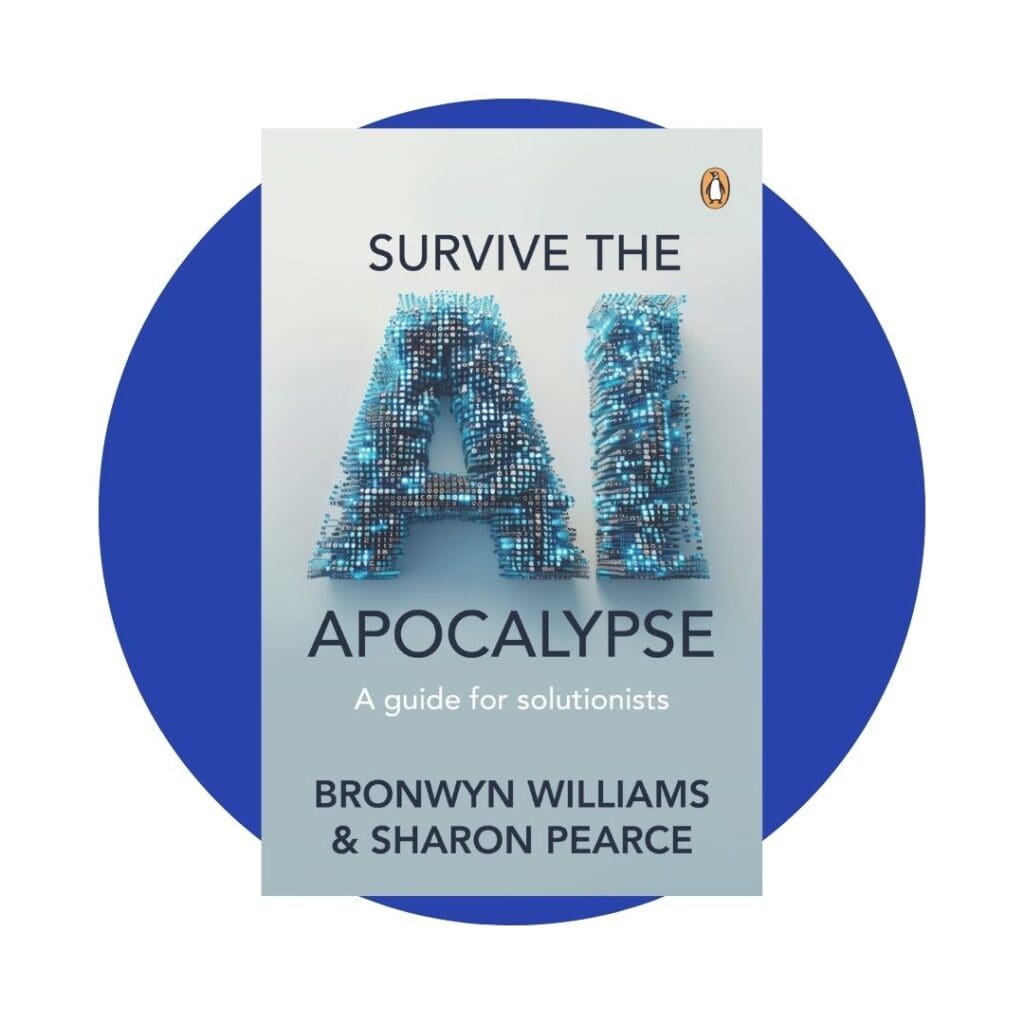
Survive The AI Apocalypse: A Guide For Solutionists is your guide to thriving in a world where nothing feels normal any more – not your newsfeed, your career or even your relationships. With AI rewriting the rules of work, value and human connection, this book shows you how to ditch the fear, sharpen your skills and become a solutionist. Instead of being replaced, you’ll learn how to turn AI into an ally, future-proof your career and build a life that can withstand – and even flourish in – the chaos of a post-AI world.
READ MORE: 5 Ways AI Healthcare is Changing Everything
Extract From Survive The AI Apocalypse: A Guide For Solutionists by Bronwyn Williams & Sharon Pearce
So, What Is A Bullshit Job?
‘Bullshit jobs’ is a term coined and popularised by the late anthropologist David Graeber in his book by the same name. He defined a bullshit job as any job that doesn’t deliver real value for anyone – not for the person doing the job, and not for any real end user. So, if you’re a checker checking a checker who is, in turn, checking a checker checking a checker, or if you’re spending hours doing the work of other people or redoing the work of other people or monitoring whether people are doing their work, ask yourself what value you’re ultimately adding. Now, if the value you think you’re adding is that you are protecting an organisation from failure, the question becomes: Are you dealing with the right problem?
To truly add value in terms of risk mitigation you need to address root risk causes – and not merely monitor risk symptoms. Otherwise, you are actually sucking value out of a system.
Busyness Without Outcome
Bullshit is the business of delivering activity. It’s as simple as that. It’s busyness without outcome. People often get the wrong idea about bullshit jobs; they think bullshit jobs are badly paid, boring jobs – the sort of jobs that make you feel sorry for the people who have to do them. In fact, they’re actually the opposite: bullshit jobs are overpaid jobs. Jobs that cost more than the value they create. They are compensated with more time and more money than they actually add to the system. A bullshit job, in fact, shouldn’t exist. That is important to clarify up front.
These over-valued self-titled ‘lazy girl’ jobs are a key category of jobs that are in the firing line with automation. They are cost centres, not value centres. They remain hidden in organisations, especially big ones, for as long as it is easy to get away with bullshit. But ultimately, bullshit jobs will be found out.

It is important to distinguish bullshit jobs – jobs that are overpaid and over-valued, unnecessary and meaningless – from necessary but nasty jobs that companies regard as grudge purchases. These jobs may be no fun to do and may or may not be adequately remunerated, but they fulfil an actual current need, even though companies or customers would prefer not to pay for these and actively look for ways to avoid paying for them.
Grudge jobs, too, will and should be automated as far as possible, but they are a separate problem companies need to deal with. Bullshit, let us be clear about it, is the primary problem in organisations at the moment, particularly in large corporations, where bullshit jobs tend to hide, thrive and multiply, internally and externally. Externally, just about the entire consulting industry is created to create, preserve, package and sell bullshit to lazy and dim-witted, fearful and naive businesses with balance sheets large enough to absorb it. These businesses perpetuate bullshit because they get paid to deal with bullshit. PowerPoint presentations and models are created and sold over and over again to organisations, promising benefits and value-at-stake – essentially, the value you’re leaving on the table, the value that would be lost – that are hardly achievable because they lack context and nuance and are often far too theoretical to ever be executed.
READ MORE: Red Flags To Look Out For When Hunting For A New Job
They’re a classic protection racket and a perfect bullshit-optimising machine. They exist; they’re there. And they’re wasteful and unsustainable – even if well paid. Internally, bullshit breeds in bureaucracy, in bloated departments, in the wake of lazy managers, in the hands of nervous checkers and in inefficient HR departments. Indeed, every person with a bullshit job is incentivised (handsomely) to protect their bullshit – and multiply it by hiring more unnecessary colleagues to keep up the guise of busyness that keeps bullshit in businesses.
Unfortunately, in the short term, people are not incentivised to deal with their own bullshit. Because bullshit is profitable – and well paid. However, not all bullshit jobs are automatable (indeed, by design many are not), and not all will be discovered through automation either. In fact, automation can protect and perpetuate bullshit at scale, and many individuals and departments in organisations are working very hard to design software ‘solutions’ that will do just that – both by accident and, unfortunately all too often, on purpose – because their jobs depend on it.
Bullshit Jobs, Bullshit Businesses
As much as we can talk about bullshit jobs and all the money that goes into supporting positions that shouldn’t really exist, there are also countless zombie companies out there that are supported either by wilfully ignorant managers who are trying to preserve their own position in their organisations or, more to the point, by unscrupulous companies trying to extract value from the system.
There are also lots of zombie companies that are propped up by government subsidies, bad legislation, too much debt or over-optimistic investor equity money in the system. These companies don’t turn a profit and add no value to any economy, but they still manage to exist because of the surpluses in and the largesse of the rest of the economy.
But just like bullshit jobs are ultimately endangered, zombie businesses too will eventually meet their demise, but not without first destroying masses of value – value for customers and shareholders.
READ MORE: Listen Up, You Need A “Get The F*** Out” Fund. Here’s How To Do It
Bullshit Economics
At its core, our whole economy is based on bad metrics. We already mentioned bad metrics at the corporate level. We measure people according to arbitrary key performance indicators (KPIs) that flatten a complex problem into a defined set of checkboxes without getting us any closer to our goals or to customer success. And as soon as we’ve done that, we automate the measurement of arbitrary tasks to effectively automate the person responsible for that task too. By measuring processes rather than outcomes like this, we make our employees replaceable and also automatable.

If you mistakenly believe that the value of your employees lies in how they match up to some rigid KPIs, or to how much activity they generate, you miss the point of hiring people at all. We make the same mistakes in the national and international economy too when we fall into the trap of believing that all value in the economy lies in the metrics that we obsessively use to measure it.
The key metrics we use to measure the success of our economy are GDP growth and employment levels – or, rather, unemployment levels. We obsess over the people who have jobs and the people who don’t have jobs. Sure, salaried workers are easier to track and tax, but is ‘employment’ really an objective for anyone? Or are we more interested in financial freedom and security – a scenario in which a job is just one means to an end (the outcome, if you like). What’s actually important?
Official employment levels are merely a proxy for what’s important, which is whether we have an economy full of people who are self-sufficient, valued by society and valuable to society. Similarly, as a business owner, do you have an organisation filled with individuals whose work leads to being valued by the client? That’s what you really want. That’s also the crux of the conversation around AI. Are we valued and are we valuable? This question gets to the heart of humanity and our whole society, and to our organisation’s purpose and culture. Value is a two-sided coin: we need to be valued by our fellow humans because all value – all margin, all profits and everything related to these measures – comes from adding value to society.
READ MORE: 12 Ways To Deal With Gaslighting In The Workplace
Simultaneously, we have to be valued fairly for our contributions. Unfortunately, instead of focusing on adding value, we use bad metrics to measure value, which have tricked and incentivised whole societies into thinking that metrics are value. But spending time ‘gaming the system’ to maximise metrics rather than adding value is simply a justification for bullshit contributions and a fast-track way to earn easy money.
Now that may be how our zero-sum economy feels. It even works in the short term for many of us. But it doesn’t offer us any future security, as we are constantly at risk of being ‘found out’. To achieve security and financial freedom, we should be spending far more time thinking about how to actually be valuable in future. This approach scales up at the corporate, national and personal levels.
Bullshit Creates Bullshit
Bullshit perpetuates more bullshit. If you’ve got someone doing a job that is devoid of value, you also need someone to justify that this job should exist. That someone is the middle manager, who also needs a manager or someone to do the work you want to manage. So, we have manager upon manager upon manager – a whole set of matryoshka dolls full of value-destroying nonsense – on which we build our economies and businesses.
Everyone is, of course, incentivised to hide that they are part of the no-added-value side rather than the real-value side of the economy. There are parallels with the instability in our global economies too. We build everything on unstable debt-based economies that are basically lies built upon lies that are again built upon lies built upon bullshit. As long as nobody looks too closely at the bullshit and nobody scratches too far beyond the surface, we all get along, and the illusion that everything is working out holds. But as soon as a crunch, an economic recession, a crisis or a war comes – all of which are happening around the world right now – suddenly the economy can’t support so much bullshit. It’s this valueless side of the hollow economy that will implode.

About The Authors
Bronwyn Williams is a futurist, economist and business trends analyst, and the co-author of several books on the future of work and society. A partner at Flux Trends and associate at Futurist.com, she writes, lectures and speaks globally on how technology and economics are reshaping our world.
Sharon Pearce is a business transformation specialist with nearly three decades’ experience helping global companies adapt and future-proof. An MBA graduate and member of the Future Talent Council, she focuses on reimagining the future of work.
Women’s Health participates in various affiliate marketing programmes, which means we may get paid commissions on editorially chosen products purchased through our links to retailer sites